Introduction
Acceptance of cheques as negotiable instruments has been a prevalent practice in commercial and personal transactions. With the increase in cheque dishonour cases, the validity of this financial instrument was under suspicion. To put an end to this evil and to preserve the integrity of bank transactions, the Negotiable Instruments (Amendment and Miscellaneous Provisions) Act, 1988 inserted Section 138 in the Negotiable Instruments Act, 1881 (NI Act), which made dishonour of cheques a criminal offence.
Section 138 seeks to encourage confidence in the effectiveness of banking transactions and discourage dishonest drawers from issuing cheques without holding proper funds. Section:138 strives for an equilibrium between safeguarding the interest of the Creditor and punishing the defaulter by a summary criminal trial while providing an option for compensation.
Statutory Framework of Section 138
Section 138 NI Act states that:
“Where any cheque drawn by a person on an account held by him with a banker. is returned by the bank unpaid, either by reason of insufficiency of funds. such person shall be guilty of the offence.”
Punishment: Imprisonment for 2 years, or Fine up to twice the amount of the cheque, or Both
Ingredients To Be Offence Under Section 138
For invoking criminal liability under Section 138, the following six conditions shall have to be fulfilled cumulatively:
- Drawer: Shall have drawn a cheque on an account held by him.
- Debt or Liability: The cheque must be drawn for the payment of a legally enforceable debt or liability, either in full or in part.
- Dishonour: The cheque is to be dishonoured by the bank due to: Insufficient funds, or it amounts to more than what was agreed.
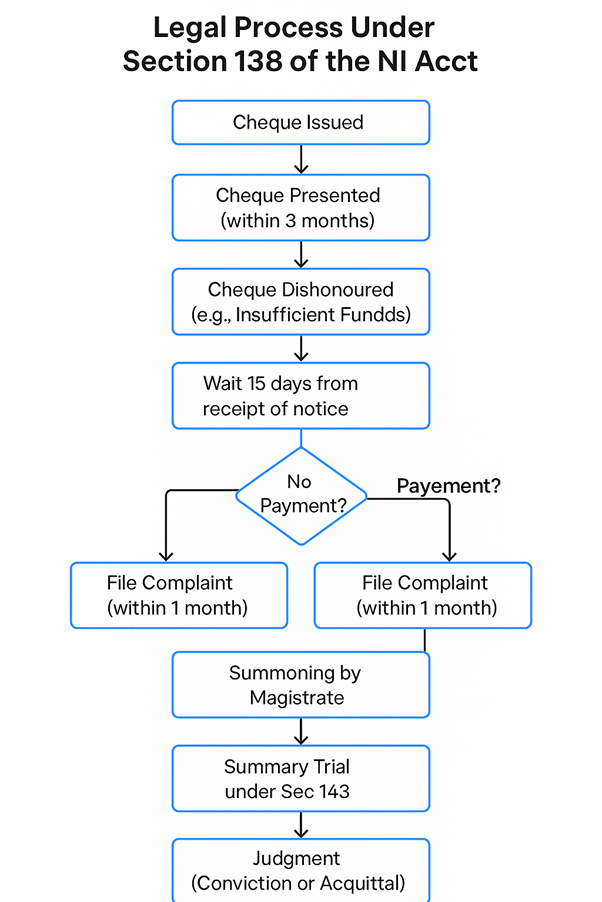
- Presentment: The cheque should be presented to the bank within 3 months from the date of drawing the cheque.
- Notice of Demand: Within 30 days of receiving information of dishonour, the payee should issue a notice in writing demanding payment.
- Failure to Pay: If the drawer does not make the payment within 15 days of receipt of notice.
- Points to Remember: Only if the drawer does not pay within this 15-day time limit, a cause of action exists for instituting proceedings under Section 138.
Procedural Aspects and Legal Proceedings Under Section 138
1) Issuance of Legal Notice To be issued within 30 days from dishonour.
The Notice must contain
- Information (number, date, bank).
- Cause of dishonour. (Insufficient Balance Notice by the Bank)
- Request for payment in 15 days.
2) Filing of Complaint
When payment is not received within 15 days, the complainant can file a complaint within one month of the cause of action date.
The Procedural method to file the complaint under the court of Law.
Previously the Complaint was filed under the Section 200 CrPC
Now Compliance with the new provisions of the 223 BNSS the complaint is filed before the Judicial Magistrate
It Should contain the following Documents for the proceedings
- The copy of the original cheque
- The copy of the Return bank memo copy of legal notice to serve by the claimant with in the 30 Days of the Receiving (attaching bank memo of the return)
- The postal receipts and affidavit of the Evidence (allowed under Sec 145 NI Act) The Cognizance and Summoning.
- The Magistrate considers the complaint and, if found satisfied with the existence of a prima- facie case
- The summons was issued by the court.
Hence, The Procedure is governed by summary trial under (Section 143 of the NI Act).
Trial
Pleadings and Evidence:
- Complainant presents her affidavit under Section 145.
- Accused can meet presumptions under Section 139.
- Defence Evidence:
- Accused can produce documents or witnesses to establish:
- No enforceable debt.
- Cheque was lost or given as security
- Final argument
Final Judgment/ Verdict of the Court
The Fine Should be imposed by the court and the Fine on the discretion of the court can be made with the interest along with the principal amount
Imprisonment can be Imposed Upto 2 Years
Compensation under Section 357 CrPC. Now the victim compensation is awarded Under Sec: 396 of The BNSS i.e. Bhartiya Nagrik Suraksha Sanhita
Case Law
In the case of Makwana Mangaldas Tulsidas v. State of Gujarat, 2020 SCC Online SC 429 the accused had forged the Signature on the cheque.
Facts of the case are as follows
Cheque dishonour (Jan 27, 2005): Two cheques totalling ₹1,70,000 were dishonoured, prompting a criminal complaint under Section 138 of the Negotiable Instruments Act
A civil suit originally arose from the bounced cheques. Criminal proceedings (summarily expected to be resolved within six months) instead dragged on for seven years before the trial court and, ultimately, 15 years in total across various judicial forums—including the Supreme Court.
Judgment Of the case
The Court Held That: There is no requirement for the complainant to establish actual “legally enforceable debt” at the stage of taking cognizance. Presumption under Sections 118 and 139 NI Act applies.
Conclusion
Section 138 of the Negotiable Instruments Act, 1881 is a significant legal provision aimed at ensuring the reliability of cheques in commercial and personal dealings. By making cheque dishonour a punishable offence, it deters fraudulent practices and reinforces trust in banking transactions. The section provides a fair mechanism with presumptions in favour of the payee while allowing the accused to present valid defences. The procedural structure, now aligned with the Bhartiya Nagrik Suraksha Sanhita (BNSS), seeks timely justice through summary trials. Overall, Section 138 maintains a balance between creditor protection and the accused’s legal safeguards
Flow Chart