INTRODUCTION
MARRIAGE UNDER THE SMA, 1954. Indian marriage has always been tied close to religion and traditions. Every religious group possesses its own individual laws that control marriage, divorce, inheritance, and so on. As an illustration, Hindus marry under the Hindu Marriage Act, Christians under the Christian Marriage Act, etc. It does not all make marriages fit within the religious lines, though. There are times that two individuals might be of different religions, castes and cultures. At times, the couples might want to get married without any religious rites and rather they would just want to undergo a basic legal process. To solve these cases, Special Marriage Act, 1954 was passed.
This Act offers a civil and secular marriage. It gives people the chance to be married irrespective of their religion, caste or community. This law is the freedom of choice and equality. It acknowledges a marriage union as legal but not religious.
PURPOSE AND SIGNIFICANCE OF THE ACT
The Special Marriage Act was introduced to protect the idea that marriage is a personal choice. It ensures that people are free to choose their life partner without being compelled to convert their religion or follow rituals they do not believe in. The Act reflects the principles of the Indian Constitution—personal liberty, equality before law, and secularism.
The Act is especially important for:
- Inter-religious couples who want to retain their individual faiths.
- Inter-caste couples facing social restrictions.
- Couples who prefer a simple, law-based marriage instead of religious ceremonies.
- Indians marrying foreigners, as the Act also extends to such marriages.
In this way, the Act encourages social harmony and respects individual identity.
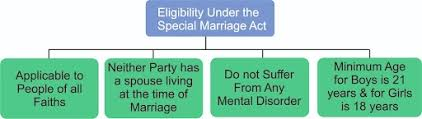
CONDITIONS REQUIRED FOR MARRIAGE
For a valid marriage under the Special Marriage Act, 1954, certain essential conditions must be fulfilled by both individuals. The male must be at least 21 years of age and the female must be at least 18, ensuring maturity. Both parties must enter the marriage voluntarily, without any force, pressure, or undue influence. The Act also requires monogamy, meaning neither person should already have a living spouse. Additionally, both individuals must be of sound mind and capable of understanding the nature of marriage and the responsibilities that come with it. Finally, the couple should not fall within prohibited degrees of relationship, such as close blood relations, except where specific customs permit such marriages. These conditions ensure that the marriage is based on free consent, legality, and social responsibility.
Minimum age: 21 years for male and 18 years for female.
Marriage must be based on free and voluntary consent.
Monogamy is required — no existing spouse at the time of marriage.
Both parties must be of sound mind and capable of understanding marriage.
The parties must not be in prohibited blood relationships, unless custom allows it.
THE PROCEDURE OF MARRIAGE UNDER THE SMA, 1954
The procedure for marriage under the Special Marriage Act is legal, formal, and public. It is carried out before the Marriage Registrar, and every step is aimed at ensuring transparency and consent. Below is the process explained in detail:
1. Notice of Intended Marriage
The first step is to give a written notice to the Marriage Registrar. This notice must be submitted in the district where at least one of the partners has lived for a minimum of 30 days before the notice is given. This requirement ensures that the Registrar has jurisdiction to conduct the marriage. The notice includes details such as the names, ages, occupations, and addresses of both parties. It acts as a formal declaration that the couple intends to marry under the Special Marriage Act.
2. Publication of the Notice
Once the Registrar receives the notice, it is displayed publicly at the Registrar’s office for everyone to see. The purpose of publishing the notice is to maintain transparency and allow any person to raise an objection if there is a legal reason that the marriage should not take place. It is important to note that objections cannot be based on personal dislike, religious differences, or family disapproval—only valid legal grounds are considered. This public notice step is what often draws attention and sometimes creates social difficulties, especially in interfaith or inter-caste marriages.
3. Waiting Period of 30 Days
After the notice is published, the law requires a mandatory waiting period of 30 days. During this period, any person can submit an objection to the Registrar, but their objection must be supported by legal reasons such as fraud, unsoundness of mind, existing marriage, or prohibited relationship. If an objection is raised, the Registrar is required to investigate it within a fixed time period. If no objection is raised, or if the objection is found to be invalid, the marriage can proceed
4. Declaration and Signing Before the Registrar
After the 30-day period has passed without any valid objection, the couple must appear before the Marriage Registrar along with three adult witnesses. In the presence of the Registrar, both parties must sign a formal declaration of marriage, confirming that they are willingly entering into the marriage. The witnesses also sign to certify that the marriage is being entered into freely and lawfully. No religious rituals or ceremonies are required here—the marriage is completed through legal signing.
5. Issuing the Marriage Certificate
Once the declaration is signed, the Registrar formally registers the marriage and issues a Marriage Certificate. This certificate is the legal proof of marriage, recognized throughout India and in foreign countries as well. It holds the same legal status as any other marriage certificate issued under personal laws. The marriage is now legally valid in every respect, including rights related to inheritance, maintenance, and property.
Note on Practical Challenges
Although the procedure is clear and legally sound, the public notice requirement often becomes a point of difficulty. Many couples—especially those entering inter-caste or inter-religious marriages—fear social pressure, harassment, or interference from families or communities. Because of this, legal scholars and activists argue that the mandatory notice period violates the right to privacy and personal liberty. However, unless the law is amended, this step remains compulsory.
SOCIAL AND LEGAL IMPACT
The SMA, 1954 has had a significant social and legal impact in India. Socially, it promotes the idea that marriage is a matter of personal choice and not merely a religious or community-based decision. By allowing individuals of different religions, castes, or cultural backgrounds to marry without converting, it encourages acceptance, equality, and cultural harmony. It challenges deep-rooted practices of caste and religious segregation, gradually contributing to social reform and modernization of thought. Legally, the Act provides a uniform civil framework for marriage, ensuring both partners are treated equally in matters of divorce, inheritance, maintenance, and property rights. It also upholds the constitutional values of freedom, dignity, and secularism by recognizing marriage as a voluntary and lawful union between two consenting adults. However, the requirement of public notice has attracted criticism due to concerns about privacy and potential harassment. Despite such challenges, the Act continues to play a vital role in protecting individual rights and enabling marriages based on choice rather than societal control.
- Encourages interfaith and inter-caste marriages, reducing social barriers.
- Promotes individual freedom in choosing a life partner.
- Strengthens the idea of marriage as a civil contract, not just a religious ritual.
- Ensures legal equality between husband and wife in terms of divorce, inheritance, and property.
- Supports the constitutional principles of secularism, equality, and personal liberty.
- Challenges social norms that discourage relationships across caste or religion.
- Public notice requirement can lead to privacy concerns and social pressure.
- Despite challenges, the Act is a progressive legal tool empowering personal choice and social reform.
CONCLUSION
The Special Marriage Act, 1954 stands as a landmark legislation that upholds the essence of personal liberty and equality in marital relationships. By offering a secular and civil form of marriage, it enables individuals to marry outside the boundaries of religion, caste, and cultural restrictions, thus promoting social inclusiveness and constitutional values. Although the procedure involves a formal and transparent process, the mandatory public notice requirement sometimes poses challenges by exposing couples to societal pressure and interference. Nevertheless, the Act remains a progressive legal framework that strengthens the idea that marriage is a matter of personal choice and mutual consent, rather than a religious or communal obligation. It reflects India’s democratic commitment to protecting individual rights and fostering unity amidst diversity.
In my view, the Special Marriage Act is an essential and forward-looking law that protects the dignity and freedom of individuals in matters of marriage. It recognizes that love and companionship should not be restricted by barriers of religion, caste, or familial control. However, the public notice requirement often contradicts the very spirit of privacy and autonomy that the Act intends to uphold. Reforming this aspect would make the Act more effective and supportive of the couples who seek protection under it. Overall, the Act plays a crucial role in shaping a more open, equal, and progressive society, where personal choice is respected and cherished.