Introduction
“यतो धर्मस्ततो जयः” – “Where there is dharma (justice), there is victory”
“None of them is to be condemned without hearing.”
This is a very fundamental principle that forms the basis of Natural Justice – a principle that provides fairness, equality, and justice in an indiscriminating decision making process particularly in administrative and quasi-judicial measures. Although the term might not be mentioned in the Indian Constitution, the doctrine of natural justice is enshrined in our jurisprudence by the means of judiciary interpretation and constitutional requirements. Natural justice is the general law of fair play and procedure which have to be observed by authorities in the aspect of exercising powers which have a bearing on the rights of individuals. The objective is to avoid miscarriage of justice, arbitrariness and biased decision. Inflated to be anchored in common laws, the notion goes beyond the legal systems. It is held to be a universal principle of justice not merely applied in courts but in tribunals, universities, public authorities and administrative bodies also.
Origin of Natural Justice
This philosophy is based on ancient philosophy, religion, and customary beliefs. Its most ancient intellectual roots can be traced to Greek philosophers such as Aristotle who provided a distinction between natural justice (universal and immutable) and legal justice (made by man and subject to change). The Romans went further to come up with the concept as jus naturale, a group of laws that were universal and were a part of human nature. Sondhi finds the same value in religious traditions of Hinduism such as the Manusmriti to, which focused on dharma (justice and fairness) and Canon Law of Christian tradition, which was focused on moral accountability and the right to be heard.
Purpose of Natural Justice
- Fairness- This blocks the lack of fairness in decisions made i.e. also unjustified or unbalanced decision making.
- Enforce Transparency-It employs reasoned orders thus triggers transparent and fair rulings.
- Quality Police Protection Protect the individual rights of life, liberty, employment and property against unreasonable act.
- Guard against Abuse of Authority -serves as a guard against the administrative and quasi-judicial powers.
- Strengthen Public Trust- improves trust in procedures of law and administration.
- Endorse Rule of Law- Preserves that the decision is based on a legal criterion, and there is a process.
- Aid Judicial Review- Gives courts the ground to reject unfair judgments.
Constitutional Basis in India
Although the Constitution of India does not directly use the term “natural justice”, the Supreme Court has read these principles into various provisions:
- Article 14 (Right to Equality): Prevents arbitrary state action.
- Article 21 (Right to Life and Personal Liberty): Procedural fairness is a part of “due process.”
- Article 311 (Dismissal of civil servants): Provides procedural safeguards akin to natural justice.
Natural justice is therefore part of constitutional morality and procedural due process.
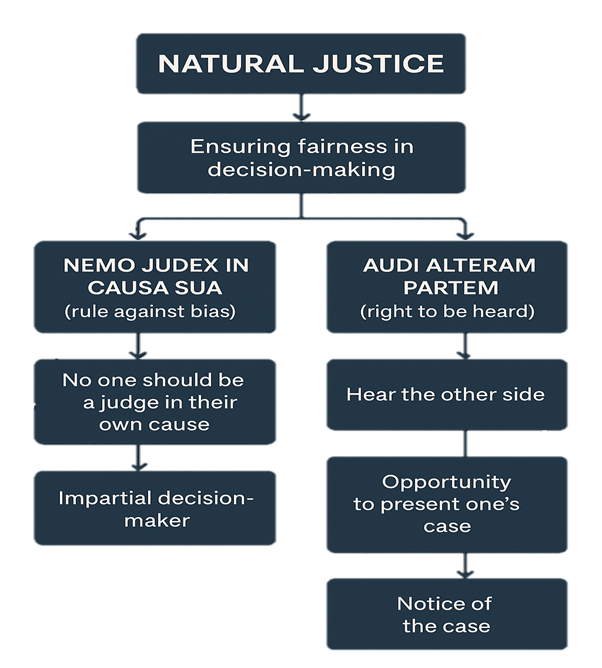
The Two Pillars of Natural Justice
Natural justice has two known principles or rules:
1. Nemo Judex In Causa Sua (Rule Against Bias)
This is a Latin phrase that translates to mean that one should not judge himself/herself. The authority that interprets a case should not be biased, personally interested, and prejudice.
Prejudice may be:
Financial interest/Pecuniary, Personal (relationship with a party), Those official (previous opinion or involvement).
Case Law: Maneka Gandhi v. Union of India (1978)1978 SCR (2) 621
The Supreme Court interpreted that procedural fairness is included within Article 21 of the Constitution and the decision to act on any liberty of a person or his/her rights have to be fair and unbiased.
2. Audi Alteram Partem (Right to Hear)
This is derived as Hear the other side. Person should never be condemned without having a chance to appear on his or her own behalf.
This includes:
intelligence of the case against them, The time to prepare, Evidence access, Right of cross examination of witnesses, An order of reasons.
Case Law: A.K. Kraipak v. Union of India (1969)SC/0427
This landmark case did not distinguish between administrative and quasi legislative functions but was of the view that any decision that affects rights must be in accordance to natural justice.
Exceptions to Natural Justice
While the rule of natural justice is foundational, there are certain exceptions where it may not be strictly applied:
- Emergency Situations – Where immediate action is needed (e.g., suspension during criminal prosecution).
- Legislative Acts – When laws are made (rules/regulations), hearing every individual isn’t practical.
- Confidential Matters – In issues of national security or confidential service reports.
- Impracticality – Where granting a hearing is impracticable due to the nature of the matter.
- Express Exclusion by Statute – Sometimes, laws may explicitly or implicitly exclude natural justice (though such exclusions are narrowly interpreted).
Case Law: Union of India v. Tulsiram Patel (1985)SC 1416
It was that there are principles of the natural justice that can be denied when it goes to the public interest or emergency dismissal.
Importance of Natural Justice
It is a core jurisprudential concept.
It is frequently tested in judicial exams and moot courts.
It applies to almost every branch of law criminal, administrative, service, and constitutional.
Conclusion
Natural justice is not merely a procedural formality it is the soul of justice. Whether in a classroom, courtroom, or corporate office, it ensures that every person is treated fairly, heard properly, and judged impartially.
In a rapidly evolving legal system like India’s, where state powers and administrative functions are expanding, natural justice remains the first line of defence against arbitrary action.
As the author, writing this blog on Natural Justice was both intellectually enriching and ethically grounding. In an age where administrative power continues to expand and impact individuals’ rights, revisiting such foundational doctrines felt urgent and necessary. Natural justice isn’t just a technical principle it embodies the moral compass of any fair legal system.
Through this blog, I aimed to demystify a seemingly complex legal doctrine and present it in a structured, accessible, and engaging format. The integration of flowcharts, historical context, and case laws was deliberate to help students, legal aspirants, and general readers grasp both the evolution and contemporary relevance of natural justice.
Moreover, writing about its origins and exceptions reinforced how justice is not just about rules but about humane processes. Whether it’s a courtroom, a university, or an office the right to a fair hearing and an impartial decision remains sacred.
Flow Chart